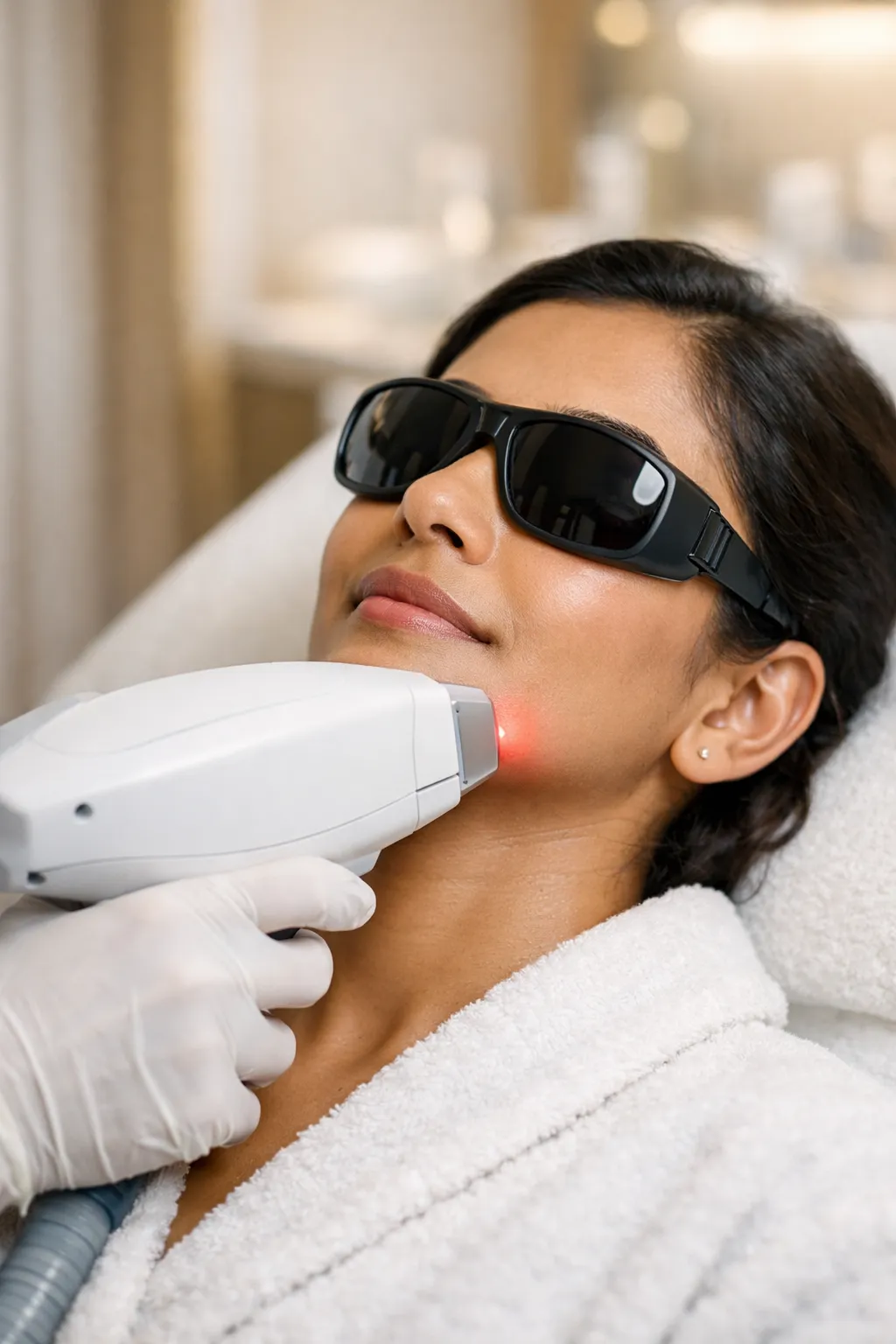
Laser hair reduction is one of the most requested treatments at dermatology clinics — and also one of the most misunderstood in terms of what it achieves and how many sessions it actually requires. The short answer: it varies considerably, and anyone who gives you a definitive number before assessing your hair and skin has not told you the complete picture.
Here is a practical guide to thinking through your treatment timeline.
How Laser Hair Reduction Works
Laser hair reduction targets the melanin (pigment) in the hair shaft. The laser energy is absorbed by the pigment, converted to heat, and conducted down to the hair follicle at the base of the hair — disrupting its ability to produce future hair growth.
The critical word is reduction, not removal. Laser treatment significantly reduces hair density and regrowth, and can achieve a very high percentage reduction in most patients — but it is not always 100% permanent for every follicle. What most patients experience is a meaningful, lasting reduction with fine, sparse regrowth that may need occasional maintenance.
Why Multiple Sessions Are Required
Hair follicles are only susceptible to laser damage during the anagen phase — the active growth phase of the hair cycle. At any given time, only a portion of follicles in a given area are in anagen. The rest are in the telogen (resting) or catagen (transitional) phases, and the laser cannot effectively damage them.
This is why a single session, no matter how thorough, cannot treat all follicles in an area. Repeat sessions at spaced intervals target successive waves of follicles entering their growth phase.
The Typical Session Range
Most patients require 6–8 sessions for body areas and 6–10 sessions for the face. However, this range is influenced by several factors:
Hair colour and coarseness: Laser works best on dark, coarse hair. The laser targets melanin — the more melanin in the hair, the more effectively it absorbs the laser energy. Fine, light, grey, or red hair has less melanin and responds more poorly.
Skin tone: The laser must distinguish between the melanin in the hair and the melanin in the skin. In darker skin tones, settings must be adjusted to avoid skin damage — which can mean more sessions at lower fluences to achieve the same cumulative result safely.
Hormonal factors: Areas driven by hormonal stimulation — the upper lip, chin, jawline, and abdomen in women — are often more resistant and may require more sessions and ongoing maintenance, particularly if the underlying hormonal cause (e.g., PCOS) is still active.
Treatment area: Body areas with denser, more uniform hair (legs, underarms, bikini) often respond faster than the face. The upper lip is one of the most treatment-resistant areas due to hormonal influence.
Interval between sessions: Standard spacing is 4–6 weeks for the face and 6–8 weeks for body areas, aligned with the hair cycle of each region. Sessions too close together or too far apart reduce efficiency.
What to Expect After Each Session
In the week following each session, treated hairs will shed. This is not new growth — it is the laser-damaged shafts being pushed out by the follicle. It can look like stubble growing in, but it is actually hair being expelled.
After each session, fewer hairs regrow — and those that do are typically finer and lighter. By sessions 4–5, most patients notice a significant visible reduction.
Normal after a session: Redness and mild swelling around follicles for 24–48 hours, similar to the appearance of small goosebumps. This is expected and resolves on its own.
What to avoid: Sun exposure immediately before and after sessions. Active tanning increases melanin in the skin, raising the risk of surface burns. Waxing and threading should be stopped — these remove the hair root, leaving nothing for the laser to target. Shaving is fine and is in fact recommended before each session.
Sessions for Common Treatment Areas
Underarms: 6–8 sessions typically achieve 80–90%+ reduction. One of the fastest-responding areas.
Legs: 6–8 sessions for dense reduction. Large surface area means longer session times but the follicles respond well.
Bikini / Brazilian: 6–8 sessions, may require 1–2 maintenance sessions annually.
Upper lip: 8–10+ sessions, particularly in women with hormonal drivers. Maintenance is often needed every 6–12 months.
Chin and jawline: Similar to upper lip — more resistant due to hormonal stimulation.
Beard shaping (men): 6–8 sessions to reduce beard density or define borders; complete beard removal requires more.
Back and chest (men): 6–8 sessions for significant reduction.
Maintenance Sessions
After completing the initial series, most patients find they need occasional maintenance sessions — typically once or twice a year — to treat the small percentage of follicles that were not eliminated and the fine regrowth that occurs over time.
The need for maintenance does not mean the treatment has failed. Even with periodic maintenance, you are still spending significantly less time and money on hair removal compared to ongoing waxing or shaving over years.
A Note on Device Type
Not all laser hair reduction devices are equivalent. The three main technologies used clinically are:
- Diode laser (e.g., 808nm): The current clinical standard for most skin and hair types; effective across a range of Fitzpatrick types; suitable for large areas
- Nd:YAG (1064nm): The safest option for darker skin types (Fitzpatrick V–VI); slightly less effective on fine hair
- IPL (Intense Pulsed Light): Technically not a laser; uses broad-spectrum light; less precise than laser and generally less effective for permanent reduction
At Ixora, we use a diode laser system appropriate for the range of skin tones typically seen in our patient population.
Getting an Accurate Estimate for Your Situation
The session count for your specific concern — your hair type, skin tone, treatment area, and any hormonal factors — can be estimated at a consultation. A test patch is also typically done before beginning a full course to confirm suitability and the appropriate settings.
If you've had laser elsewhere with limited results, this is also worth discussing — in many cases, the issue was incorrect settings, suboptimal device type, or intervals that were too short or too long.