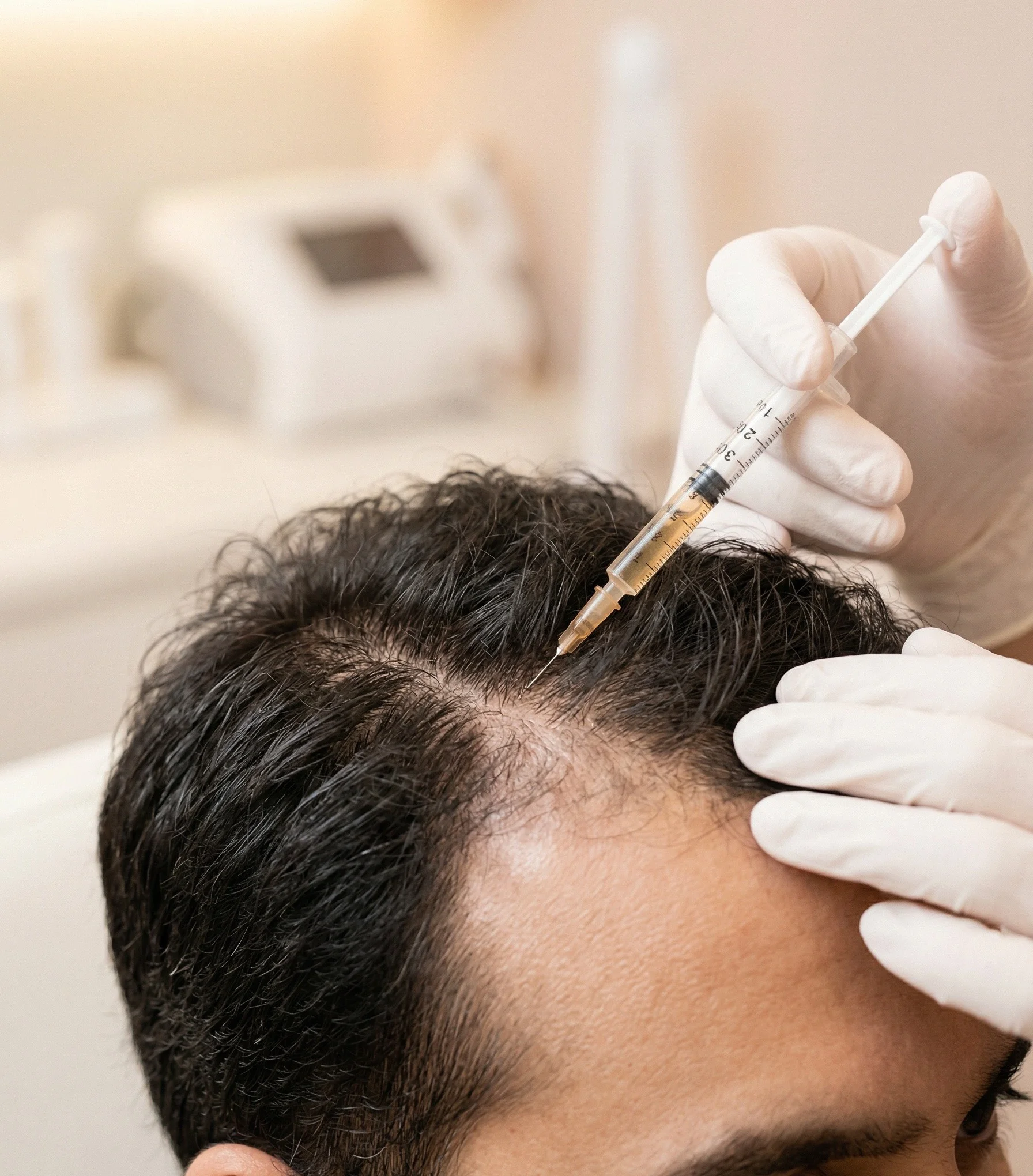
If you've been researching non-surgical options for hair loss, you've likely come across both PRP (Platelet-Rich Plasma) and GFC (Growth Factor Concentrate) therapy. They look similar on the surface — both involve drawing your blood, processing it, and injecting it into the scalp. But the science behind them is meaningfully different, and so are the results.
What Is PRP?
PRP stands for Platelet-Rich Plasma. The process involves drawing a small amount of blood, spinning it in a centrifuge to separate the platelets from red and white blood cells, and then injecting the platelet-rich layer into the scalp.
Platelets carry growth factors — proteins that signal the body to repair tissue and stimulate cell growth. When injected into areas of thinning hair, these growth factors can prolong the anagen (active growth) phase of the hair cycle and improve follicle health.
PRP has been used in medicine for decades — in orthopaedics, wound care, and aesthetics — and its application for hair loss is well-documented.
What Is GFC?
GFC — Growth Factor Concentrate — is a more refined evolution of PRP. Rather than injecting the entire platelet-rich plasma layer, GFC therapy involves an additional step that specifically concentrates and activates the growth factors within the platelets before injection.
The result is a preparation that is:
- Higher in growth factor concentration compared to standard PRP
- Free of red blood cells, which can cause post-injection discomfort and inflammation
- More stable, because the growth factors are activated in a controlled manner
In practical terms, GFC delivers a more targeted dose of the signalling proteins that matter most for hair follicle regeneration — with less procedural discomfort and typically less scalp redness afterward.
Key Differences at a Glance
Preparation time: PRP takes roughly 10–15 minutes to prepare; GFC requires an additional activation step, adding 15–20 minutes.
Growth factor concentration: GFC consistently delivers higher concentrations of key growth factors including VEGF, PDGF, and EGF.
Post-injection comfort: Because GFC removes the red blood cell component, patients typically experience less scalp soreness and fewer injection site reactions.
Session frequency: Both protocols generally involve 3–4 initial sessions spaced 4–6 weeks apart, followed by maintenance every 4–6 months.
Which One Is Right for You?
Both options are appropriate for androgenetic alopecia (pattern hair loss), diffuse thinning, and early-stage hair loss. They are not a replacement for hair transplant surgery in cases of advanced loss — but they can be used alongside transplant procedures to support graft survival and improve donor area density.
GFC tends to be preferred when:
- You've had PRP before with limited response
- You want to minimise procedural downtime and discomfort
- You're looking for the most concentrated formulation available
PRP remains a valid and effective option — particularly for patients who respond well to it, or where GFC is not yet available at a clinic.
At Ixora, we use GFC as our primary protocol for scalp therapy because of the consistency of results and the improved patient comfort profile compared to standard PRP.
Realistic Expectations
Neither GFC nor PRP grows hair where follicles are completely gone. These are preservation and stimulation therapies — they work best when there is still active (if thinning) hair present.
Most patients begin to notice a reduction in hair fall within 4–6 weeks of the first session. Visible density improvement typically becomes apparent after 2–3 sessions. A full assessment at the 3-month mark allows us to evaluate the response and plan maintenance.
If you are unsure whether GFC or a surgical option is more appropriate for your degree of loss, a scalp assessment at consultation can clarify the path forward.