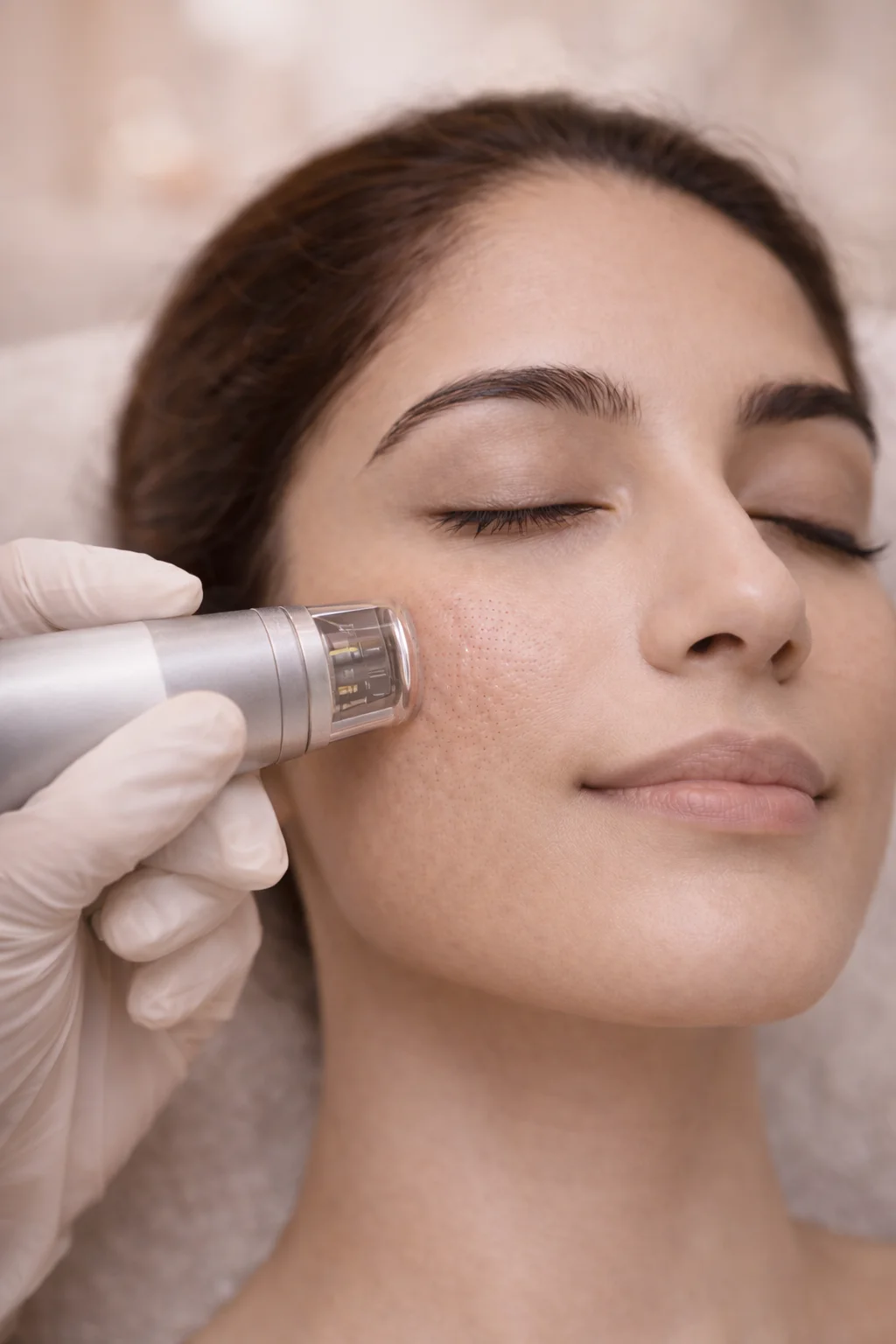
MNRF (Microneedling Radiofrequency) and fractional laser are both considered advanced skin resurfacing and remodelling treatments. Both work by creating controlled micro-injuries in the dermis to stimulate collagen production. Both are used for acne scars, skin laxity, texture, and pore size. Both deliver meaningful results.
But they are not the same — and for certain skin types and concerns, one has a clear advantage over the other.
How Fractional Laser Works
Fractional laser delivers concentrated beams of laser energy in a grid pattern, creating thousands of microscopic treatment zones — areas of controlled thermal damage — in the skin. The surrounding untreated skin facilitates faster healing.
The laser energy heats and vaporises tissue (ablative) or heats without vaporising (non-ablative) depending on the device and settings. At Ixora, the fractional laser is used for resurfacing applications including:
- Acne scar improvement (particularly boxcar and rolling scars)
- Skin texture and tonal irregularities
- Fine lines and mild to moderate laxity
- Post-procedure collagen remodelling
The thermal energy from the laser primarily targets water in the skin — and because it is a light-based technology, it is more melanin-sensitive than radiofrequency.
How MNRF Works
MNRF (Microneedling Radiofrequency) delivers radiofrequency energy through an array of tiny insulated needles that are pressed into the skin. The RF energy is released at the needle tips — below the skin surface, in the dermis and subdermis — without significant heating of the overlying epidermis.
Because the energy is delivered beneath the surface through mechanical channels (the needles), the treatment is not affected by skin pigmentation. Radiofrequency is colour-blind — it works equally across all Fitzpatrick skin types.
MNRF is particularly effective for:
- Acne scar remodelling — especially in darker skin where laser risks are higher
- Skin tightening and laxity (subdermal RF stimulates collagen and elastin effectively)
- Open pores
- Active acne (certain settings)
- Stretch marks
The Key Difference: Skin Type Safety
This is the most clinically significant distinction.
Fractional laser, particularly ablative variants, carries a higher risk of post-inflammatory hyperpigmentation (PIH) in darker skin tones (Fitzpatrick III and above). South Asian patients — the primary patient population in Kashmir — are predominantly Fitzpatrick III–V. This doesn't mean fractional laser is contraindicated in darker skin; it means settings must be conservative and the protocol carefully managed.
MNRF, because it delivers energy below the epidermis, largely bypasses this risk. The epidermis is not thermally damaged, so the melanocyte response that causes post-treatment darkening is minimised.
For darker-skinned patients treating acne scars or general resurfacing, MNRF is often the safer first choice. For patients with lighter skin who want more aggressive surface resurfacing or textural improvement, fractional laser may offer faster, more visible results.
Downtime Comparison
Fractional Laser: The skin appears red and feels sunburned for 3–5 days post-treatment. Skin peeling or flaking is common from days 3–7. Sun avoidance and a simplified, calming skincare routine are essential for at least 2 weeks. Makeup can generally be applied after 5–7 days.
MNRF: The skin appears red and feels warm for 24–48 hours. Pinpoint marks from the needles are visible for 1–2 days. Most patients are comfortable returning to normal activity within 48 hours. The epidermis heals faster because it is not the primary treatment target.
For patients who cannot afford extended downtime — or who are concerned about going out looking visibly treated — MNRF has a practical advantage.
Session Planning
Both treatments typically require a series of sessions for optimal results:
- Fractional laser: 3–5 sessions spaced 4–6 weeks apart, with results continuing to improve for up to 6 months after the last session
- MNRF: 3–4 sessions spaced 4–6 weeks apart; collagen remodelling peaks at 3–6 months
Maintenance sessions once or twice a year help sustain results in both cases.
Can They Be Combined?
Yes — and in some patients, they are used sequentially. For example, MNRF may be used for deeper dermal tightening and scar remodelling, followed by a lighter fractional laser pass for surface texture refinement, once the skin has fully healed from the first modality.
The combination approach is not always necessary and adds cost and total downtime. Whether it is warranted depends on the individual concern profile.
Summary: How to Choose
Choose MNRF if:
- You have darker skin (Fitzpatrick III–V) and are concerned about post-treatment pigmentation
- Your primary concern is acne scars, skin laxity, or open pores
- You have limited downtime
- You have had PIH reactions to previous aesthetic treatments
Choose Fractional Laser if:
- Your skin tone is lighter and the risk of PIH is lower
- You want more aggressive surface resurfacing
- Fine lines and textural irregularities are the primary concern
- You are comfortable with 5–7 days of visible recovery
For most patients at Ixora presenting with acne scars, we begin with MNRF because of our patient demographic and its superior safety profile in darker skin. After initial results are assessed, fractional laser can be considered for surface refinement if appropriate.
A formal consultation with a skin assessment — including Fitzpatrick typing and a scar morphology evaluation — is the right way to decide. The answer is specific to your skin, not a general preference.
Explore treatments at Ixora: MNRF · Fractional laser · Acne scar treatments · Book a consultation